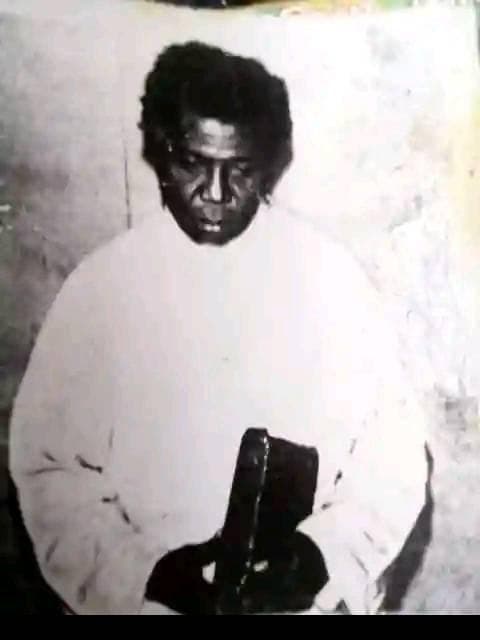
Born on March 26, 1926, in Idiogba to Pa Ajimuda Philips of Idiogba and Mrs. Ketura Ajimuda (née Akinnire) from Motoro, Prophet Mennary began his elementary education at St. Paul’s Anglican Primary School, Idiogba, in 1932. While his mother was pregnant with him, she was gifted with remarkable spiritual abilities—she could see visions, prophesy, and operate in other gifts of the Spirit. These manifestations continued until the day she gave birth to him, after which the gifts were withdrawn.
God granted this prayer abundantly—over his lifetime, he authored more than 5,000 hymns, earning him the titles “David of Our Time” and “King of Zion Hymnists.”
He was a pioneering member of Zion performing musicians and authored many Zionist musical albums, including:
“Ìgbìn Ayé wọ̀nù àwọn Alùfá”
“Ùgbọ̀n-nlá, Lene fi ẹ̀mí tẹ́do”
“Ẹ̀ gbìn, ẹ̀gbìn nígbèhìn àdùn ayé yìí”
“Olóba wẹ́nòṣo, Olóba wẹ́ nàjé”
These inspirational, healing, and thought-provoking hymns were embraced by Christian fellowships and evangelistic revivals worldwide, especially across all Zion Churches.
Chapter 02 · 1947 – 1953
Spiritual Awakening and Ministry Foundation
On October 17, 1947, at the seashore of Obejedo in Ilaje Local Government Area, Ondo State, he was on his way to play Jolly with his band when he received his first profound spiritual inspiration and deep call from God. A week later, on October 24, 1947, he was baptized by Rt. Rev. Gabriel Jedo, Aladura Isaiah Shedara, and Aladura Wilson Metejo Ugboko.
Soon afterward, he was spiritually guided to Motoro in Ilaje L.G.A., where he established a church with companions including Baba Alakoso L. B. Asemudara, Cherubim Elizery Faro, and Baba Alakoso E. Ikuleogbon. Following the counsel of Prophet Mustard Woro Akintimehin, they decided to serve as a branch under Ugbonla Headquarters, choosing Prophet Mustard Woro as their leader.
He later migrated to a village called Okomuta in what was then Cross River State for fishing under the tutelage of Baba Aladura Egbowon. During his time there, he proved to be a careful chronicler, meticulously documenting his music in series such as “Orin Mímọ́ The Hermer Romission,” “Orin Èkún Alórè,” and “Orin Mímọ́ Mennary Sainary Alórè Jesu”, often noting the date, day, and events surrounding each song’s inspiration.
Chapter 03 · August 23, 1953
The Divine Visitation at Mount Herramar
On August 23, 1953, an angel named Mennary appeared to him in a vision and transported him to the Mount of Herramar. For seven consecutive days and seven consecutive nights, he remained immersed in the Spirit. During this extraordinary spiritual encounter, he received multiple divine gifts:
Sainary garments and garment underwears (pẹ́tì)
Sash (àmùré)
Angelic languages for songs and prayers
The spiritual songs of Sencity, Elo Harmmar
A torrent of prophetic inspiration
Seven spirits and seven seals
In that sacred encounter, he sang: “Nínú Ẹ̀ fà tó tó kọjá, lọ́jọ́ kẹtàlélógún, mo ń lọ sí ilé Ọlọ́run mi,” marking his complete journey into God’s fullness. Because of these songs and angelic languages he received, he was henceforth called Mennary Alórè Jesu—“Messenger of God”. His songs serve as a seal that has united all the churches together.
Chapter 04 · Okomuta
The “Siloh Ti De” Movement and Holy Center
While in Okomuta, he founded a gospel band and movement called “Siloh Tí Dé,” preaching Christ across the area and establishing the Holy Center at Oke Eri, Okomuta. This became a hub of worship, prayer, and music where he sang many hymns, including notable compositions such as:
On November 27, 1955, he was spiritually directed to preach in Ilaje. On November 30, 1955, he embarked on the journey to Ilaje, preaching the gospel at Ibajakare, Odun Oyibo, Ajegunle, and Ugbonla. In Ugbonla, the message was met with severe hostility. Accused of preaching without due permission, he was flogged, wounded, and publicly punished for three days by the committee.
On December 18, 1955, he moved to Ori Oke Iwa Mimo, where his wounds were treated by King Oba Alafia, the Ogbon Olorun of Oke Iwamimo. At Ori Oke, he joined the Church of the Apostles and began itinerant preaching, visiting Mogbojuri, Zion-Pepe, and other towns to proclaim the Gospel of Christ.
At Zion Pepe, he worshiped with Baba Mafo (the founder of Episcopal Zion) and his senior colleague Baba Omowole (V.O.G 1). In the midst of this ordeal, he sang “Mo dúpẹ́ lọ́wọ́ Oluwa tó fi ẹ̀rí ìhìn rere fún wa, tó fi èdídí Òtítọ́ fún wa”, expressing thanksgiving to God for the seal of truth and good witness, and giving an account of his missionary journey to Ilaje. He also stated his reasons for going to Ugbonla in verses 2 and 3 of his collaboration song with Baba Wole, “Ṣọ fún mi Olùgbàlá,”.
He later returned to Okomuta in what was then Cross River State before a new chapter opened.
Chapter 06 · 1960
Ordination and Innovations
In 1960, Baba Lene recalled him to Ugbonla, where he was trained, ordained as a Prophet, and appointed Choir Master General to teach the choir members the Zion songs. Through him, Zion received distinctive innovations that transformed worship:
“Sainary” garments and garment underwears
Numerous Zion garment styles
Zion hats and Zion head-wears (ìborí)
The trumpet
Chorister Anniversary
A rich body of Sainary songs
On two further occasions, he faced persecution and migrated to Sapele and Seja-Oke respectively, but each time he was recalled and vindicated by Baba Lene. These were also accounted for in hymns, with one of them being “Ìhìn rere Jesu, Iṣẹ́ Ìyanu Jesu, ló mú mi gùn Òrí-Òkè Ugbonla.”
His ministry expanded significantly to the Ijaw and Apoi lands, Rivers and Bayelsa States, drawing many converts into Zion. God used him to perform many miracles with living witnesses remaining: the barren conceived and became fruitful, the sick were healed, and broken lives were restored.
Chapter 08 · Gabon · Cameroon · Rome · London
International Ministry and Titles
As Baba Lene’s first-class emissary, he traveled to numerous towns, cities, and nations—including Gabon and Cameroon—and joined the entourage on missionary journeys to Rome and London. On the flight to Rome, moved by the Spirit, he sang in Italian: “Dio, Dio, Dio protegga me, Ti telefono Oggi, Dio protegga me”, a song that recounts the journey to Rome.
Baba Lene conferred upon him many titles reflecting his spiritual authority and responsibilities:
Prophet
Apostle
Senior Apostle
Superior Senior Apostle
“The smallest that is mightier than thousands”
Tutor-General/Speaker for the Seraphic School of Theology (Ugbonla Headquarters)
Choir Master General
Centre Chairman
Baba Alakoso
One of the first three Boanerges
Chapter 09 · 1996 – 2010
Final Years and Legacy
After Baba Lene passed away on March 28, 1996, Prophet Mennary pressed on with the work, celebrating the Annual Zion Choristers Anniversary at:
Bolowou (1997)
C&S Church of Zion, Rabbakka, Ikorodu, Lagos (1999)
C&S Church of Zion, Idapo Mimo, Ojo, Lagos (2000 – 2001)
Itedo Alore Zion, Ojo Lagos (2000 – 2010)
On September 28, 1998, during the onset of the Ijaw–Ilaje crisis, Baba Mennah left Ugbonla for Lagos. In 2010, he marked the Golden Jubilee of the Zion Choristers Anniversary—celebrating 50 years of this significant tradition—before he was finally called home and succumbed to the cold hands of death.
Chapter 10 · Family and legacy
Personal Life and Enduring Impact
Prophet Mennary Sainary Nathan Ajimuda was blessed with many wives, children, grandchildren, and great-grandchildren, reflecting God’s abundant blessings in his personal life.
His legacy lives on through his hymns—each one a living testimony of his walk with God—which continue to lead worshippers to Christ and unite Zion churches worldwide. These songs chronicle his personal story and deep encounters with God, ensuring that his voice still sings in the church of God today, inspiring generations of believers across the globe.
Keep these hymns alive
Free to use. If these hymns have blessed you, a gift towards the mission helps keep them coming. Thank you.